
AI in Advertising: How the Future of Marketing is Being Shaped
2025-12-16
Creating ad content using Artificial Intelligence (AI) is no longer a distant concept; it has become an inevitable trend, fundamentally redefining how businesses approach their customers. The integration of AI into marketing campaigns—particularly through applications like Facebook Ads AI—is unlocking unprecedented opportunities to optimize performance, enhance creativity, and drive cost efficiency.
I. Understanding AI-Driven Ad Content
AI-generated advertising content represents a breakthrough trend in the advertising sector. These are digital advertisements designed not solely by human creators, but by advanced AI algorithms and machine learning protocols. From writing persuasive sales copy to composing music and generating visual designs, artificial intelligence empowers brands to innovate continuously to meet the increasingly high creative demands of the advertising industry.
At its core, AI creates content by analyzing and extracting knowledge from massive datasets. specifically:
AI learns from data: AI is “trained” by processing terabytes of textual data from books, newspapers, and websites. This allows the AI to recognize patterns, structures, and linguistic rules. This process enables the AI to understand the context, tone, and style appropriate for specific types of content.
Machine Learning Models: AI utilizes complex machine learning models, most notably deep neural networks and Natural Language Processing (NLP). Thanks to this, AI can predict the next word or phrase, constructing sentences, paragraphs, and even complete articles that are coherent and logical.
Automated Content Creation: Based on this learned knowledge, AI can generate content automatically based on user requests. By simply providing keywords, objectives, and topics, AI will rapidly create suitable content, ranging from catchy headlines to detailed product descriptions.
The creation of AI ad content is elevating advertising creativity to unprecedented heights by automating content generation without compromising quality. AI can generate countless ad variations, performing A/B testing on a massive scale to identify the most effective elements.
II. The Benefits of AI in Ad Content Creation
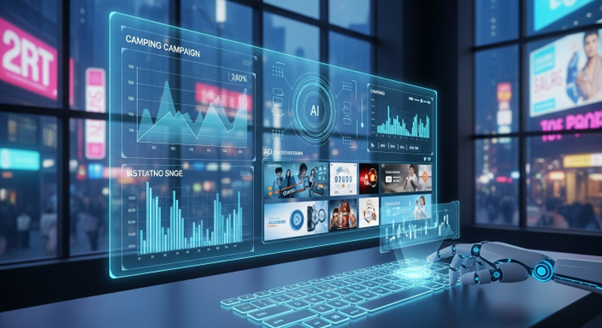
Applying AI to the creative process offers superior benefits, helping businesses optimize their marketing strategies:
1. More Effective Targeting
AI analyzes extensive customer data (online behavior, interests, demographics) to target the right audience with high precision. This not only increases conversion rates but also ensures every advertising dollar is spent as effectively as possible.
2. Automation and 24/7 Performance
AI helps automate repetitive tasks such as creating ad variations, keyword optimization, or budget allocation. This frees up time and resources for the marketing team to focus on high-level strategies, while ensuring campaigns operate effectively around the clock without the need for constant human intervention.
3. Enhanced Creativity and Innovation
AI has the capability to identify creative elements that capture attention, generating fresh and unique ideas and visuals that humans might take much longer to conceive. By analyzing billions of data points regarding successful ads, AI can suggest sentence structures, imagery, or music likely to resonate with the target audience.
4. Increased Customer Satisfaction
Thanks to content personalization capabilities, AI helps create ad experiences that are more relevant and tailored to each individual, thereby enhancing customer satisfaction and brand loyalty.
5. Boosted Multi-Channel Engagement
AI supports the creation of content that is optimized and suitable for various media channels, from social media and email marketing to display advertising. This helps strengthen engagement levels across the entire customer journey.
6. Cost Efficiency
AI minimizes human resource costs and time through automation and process optimization. Businesses can achieve higher efficiency at a lower cost, delivering a better Return on Investment (ROI) for advertising campaigns.
III. Harnessing the Power of AI Platforms in Advertising
Today’s AI advertising platforms offer numerous standout features that businesses can exploit to gain a significant competitive advantage:
1. Generative AI for Ad Creative and Design
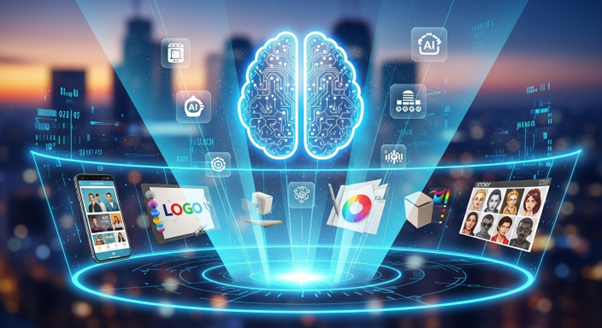
Generative AI technology allows for the rapid creation of unique, high-quality images, videos, and graphic elements. These tools can generate endless variations based on brand assets, helping businesses test multiple creative concepts without incurring excessive design time and costs.
2. AI-Powered Programmatic Advertising
AI optimizes ad delivery in real-time, ensuring they appear to the right audience at the right time and on the most suitable platforms. This helps improve ad spend efficiency and maximizes valuable impressions.
3. Conversational AI for Customer Engagement
Chatbots and AI virtual assistants not only facilitate 24/7 customer interaction but also personalize the experience by answering questions, guiding purchases, and collecting feedback. This improves customer service and strengthens engagement.
4. AI for Predictive Analytics & Campaign Optimization
AI analyzes historical data to predict trends, customer behavior, and future campaign performance. Based on these predictions, AI can offer real-time optimization recommendations, from budget adjustments and audience selection to refining advertising messages.
5. AI and Privacy-First Advertising
In a future without cookies, AI provides alternative solutions to personalize ads while still ensuring user data privacy. AI uses techniques like federated learning and anonymous data modeling to guide intelligent creative direction, make data-driven recommendations, and execute A/B testing at scale without violating privacy regulations.
IV. Facebook Ads AI in Marketing Operations
Facebook is one of the platforms leading the charge in applying AI to advertising, bringing numerous advantages to marketers through its powerful machine learning system:
1. Real-Time Campaign Optimization
Facebook Ads AI applications continuously analyze thousands of signals from social media users (likes, comments, shares, scroll behavior, video watch time, etc.) to optimize campaigns in real-time. This ensures ads are always displayed to those with the highest probability of interaction and conversion.
2. Intelligent Automated Budget Allocation
With features like “Campaign Budget Optimization” (CBO), dynamic AI automatically shifts budget to the ads and audiences delivering the highest efficiency within a campaign. This helps maximize ROI without the need for constant manual intervention.
3. Lookalike Audience Functionality
This is one of the most powerful tools within Facebook Ads AI. This function analyzes the detailed characteristics of current customers (or those who have interacted with the business) and builds a model to find new users with similar traits on Facebook. This technique creates potential customer segments with high accuracy, expanding reach opportunities while ensuring relevance and effectiveness.
4. Image and Ad Format Optimization
Facebook’s AI can automatically adjust sizes, formats, and even minor elements within ad images/videos to suit specific display placements (e.g., News Feed, Stories, Reels) and devices, ensuring an optimal user experience and the highest advertising effectiveness.
5. Automated A/B Testing Strategy
Facebook Ads AI allows advertisers to easily execute A/B testing campaigns with multiple variations (images, headlines, audiences) to discover which elements perform best. The AI will automatically learn from these test results and optimize ad performance continuously and automatically.
With these capabilities, Facebook Ads AI helps businesses reach the right audience, optimize budgets, and significantly enhance advertising effectiveness.
V. Challenges When Applying AI to Advertising
Although AI brings many benefits, its application in advertising also comes with certain challenges that businesses need to note:
Trust and Acceptance: Some businesses and consumers remain skeptical about AI’s ability to create quality, trustworthy, and “soulful” content. Sometimes, AI-generated content may lack the uniqueness, emotion, and storytelling ability that humans bring.
Data Privacy Concerns: AI’s collection and analysis of big data for ad personalization raise serious questions about personal information security and user privacy. Regulations like GDPR or CCPA are becoming increasingly strict, requiring businesses to ensure compliance and transparency in data usage.
Risk of Algorithmic Bias: If the AI training data contains bias, the algorithms may reproduce or even amplify social prejudices, leading to unfair targeting or the creation of inappropriate content.
The Human Role: There are concerns that AI will completely replace the human role in the advertising industry, leading to job losses. However, reality shows that AI should be viewed as a support tool, helping humans focus on more complex creative, strategic, and managerial tasks.
Implementation Costs and Required Skills: Deploying advanced AI systems can require significant initial investment and a workforce with specialized skills in AI and data science.
To overcome these challenges, the following solutions are needed:
Combining AI with Human Creativity: Use AI to automate repetitive tasks and provide insights, while humans focus on strategic aspects, creativity, and ensuring content retains the brand’s unique “substance.”
Prioritizing Privacy and Ethics: Establish clear regulations on data protection, use data transparently, and develop fair, unbiased algorithms.
Training and Skill Development: Focus on retraining the workforce so they can collaborate effectively with AI, transitioning from traditional roles to more strategic and creative positions.
VI. The Future of Advertising with AI’s Creative Intelligence
The creative intelligence of AI is transforming advertising profoundly; it is not just a tool but a factor reshaping the entire industry. AI provides the capability for super-personalized ad creation, instant adjustment, and limitless creativity, delivering a significant competitive advantage for businesses in the current market context.
The AI we know today has moved beyond simple automation. Current advancements allow AI to create ads precisely, learning from every interaction, every click, and every conversion. AI today does not just work harder; it works smarter.
1. Getting Ahead with AI in Ad Content
Applying AI in ad content is essential for every business wanting to maintain competitiveness and growth. Success in advertising today is not just knowing where the audience is, but knowing who they are, what they want, and how you can provide it. AI can provide you with these detailed insights quickly and accurately.
Leveraging AI strategies in advertising combines human creativity with modern technology, ensuring high personalization while still complying with data privacy laws. This offers a balanced yet powerful approach for businesses aiming for technology-driven success.
2. Tips to Lead the Advertising Industry with AI
The advertising industry is constantly evolving, and the advent of AI in advertising marks one of the most significant shifts. To stay ahead, businesses must:
Continuously Learn About Advancements:
Stay updated on AI and machine learning knowledge, understanding how these technologies can benefit the brand and drive your ad campaigns. AI is developing at a breakneck speed, and updating on new trends is critically important.
Integrate Data and Analytics into Every Stage:
Incorporate AI-driven data and analytics into every stage of the ad campaign, from planning to execution and evaluation. This helps make decisions based on accurate information, not intuition.
Test and Adapt: Constantly test new AI tools and strategies. The market is always changing, and readiness to adapt is the key to maximizing AI’s potential.
Remember, leading with AI in ad content means always being ready to explore, apply, and leverage the latest AI developments in advertising to outperform competitors.
Conclusion
AI is not merely a support tool but a strategic partner helping businesses optimize marketing operations, specifically in creating AI-generated ad content. From data analysis and content personalization to campaign optimization on platforms like Facebook Ads, AI is revolutionizing how we approach and interact with customers.
Proactively exploiting the power of AI is a vital factor for businesses not only to sustain but to breakthrough. Are you ready to leverage AI to elevate your advertising strategy?
Related Journals