AI in Game Development: Breathing Life into Characters and Revolutionizing Production Pipelines
2024-01-25

The gaming industry has undergone a seismic shift—not just in graphics or storylines, but in how interactive and immersive digital worlds have become. At the heart of this evolution is Artificial Intelligence (AI). Once limited to predictable, script-based behavior, non-playable characters (NPCs) are now dynamic, intelligent, and emotionally responsive thanks to AI.
This article explores how AI is not only transforming NPCs into lifelike entities but also optimizing entire game development workflows. For studios and agencies, understanding AI’s role is essential to stay ahead in this billion-dollar entertainment arena.
I. AI Creates Lifelike, Autonomous Game Characters
1. Complex, Autonomous Behavior
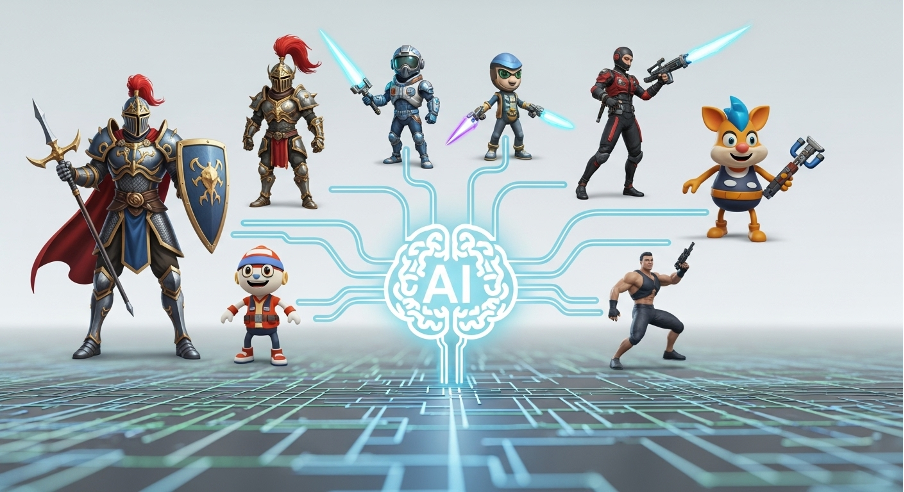
Modern AI enables characters to make independent decisions rather than follow rigid pre-programmed commands. Instead of walking predefined paths, AI-powered NPCs explore environments, gather resources, and react dynamically to unexpected events. In open-world games, NPCs live out routines—working, shopping, interacting—which simulate a vibrant virtual society.
The result? Highly immersive, unpredictable gameplay, where player interactions trigger varied, context-aware NPC responses.
2. Emotions and Flexible Interactions
Using Machine Learning and Natural Language Processing (NLP), AI empowers characters to “understand” context and player intent, responding with realistic facial expressions, gestures, and voice tone.
From traditional state-machine AI (rule-based, predictable behaviors) to behavior trees (context-aware action prioritization) and neural networks (adaptive learning), today’s AI systems allow characters to evolve, learn from players, and mimic complex human behavior.
3. Smarter Enemy AI = Greater Challenge
AI doesn’t just enhance allies—it creates smarter opponents. Enemy AI now adapts to player behavior, switching tactics depending on the player’s combat style. For example:
If a player uses melee attacks, AI may shift to ranged defense.
If a player snipes from distance, AI may flank or aggressively close the gap.
This creates more tension, personalization, and strategy in combat, especially in RPGs, strategy, and competitive games.
II. AI Applications That Optimize the Game Development Pipeline
1. Procedural Content Generation
AI enables automatic creation of game assets like maps, quests, landscapes, buildings, and environments using procedural generation. Developers provide a set of rules; AI does the rest.
Benefits:
Save time & labor: Reduces manual asset design
Content diversity: Endless variety enhances exploration
Replayability: Dynamic maps and missions keep players coming back
Smaller file sizes: Store generation algorithms instead of full datasets
Example: AI generates billions of unique planets with ecosystems in space-exploration games.
2. QA Automation and Testing
AI-powered agents simulate thousands of gameplay hours, auto-identifying bugs, glitches, and system failures. They execute repetitive test cases faster and more accurately than human testers.
This frees QA teams to focus on complex tasks like balance testing and user experience. Ultimately, AI ensures games ship with fewer bugs and higher polish.
III. The Future of AI in Gaming: Vision for Studios and Agencies

AI’s future in gaming is expansive:
Generative AI will create dynamic stories, dialogue trees, and entire characters with backstories.
Hyper-personalization: AI will analyze player behavior, skill level, and preferences to adjust difficulty, suggest missions, or modify the world itself.
For studios, integrating AI is no longer optional—it’s essential. Yet AI deployment requires technical depth—from algorithm development to system integration. This is where technical agencies become vital.
At Reputyze Asia, we combine engineering with creative vision, offering full-stack AI-powered solutions for studios. From roadmap to implementation, our all-in-one service helps bring bold AI gaming ideas to life, affordably and effectively.
IV. Conclusion: AI—The Golden Key to Next-Gen Gaming Experiences
AI is fundamentally redefining how games are built and experienced. It breathes life into NPCs, adapts to players in real time, and streamlines development processes from asset creation to QA.
In an increasingly competitive market, mastering AI tools is crucial to stand out. Whether you’re an indie studio or an established developer, now is the time to leverage AI for immersive, intelligent, and unforgettable gameplay.
Reputyze Asia is here to help you unlock your vision. Let’s create game worlds that think, feel, and evolve. Together.
Related Journals