3 Secrets to Optimizing Multimedia Content Production for Accelerated Conversions in SEO and Social Media 2025
Date: 2025-03-15

In an increasingly competitive online environment, businesses are actively seeking effective ways to reach and engage with potential customers. Multimedia content, encompassing articles, images, videos, podcasts, and infographics, has become the core element shaping how brands interact with their audiences. However, creating engaging content is only the starting point. For this content to truly deliver value and achieve business goals, effective optimization for Search Engines (SEO) and Social Media platforms is essential.
This article provides an in-depth look at the strategies and techniques for optimizing your multimedia content production. We will explore how to leverage the synergistic power of SEO and Social Media, from understanding search algorithms to building brand credibility, ensuring your content not only achieves high rankings on Google but also spreads widely across social channels, contributing to conversion acceleration and business growth.
I. The Relationship Between SEO and Social Media in Digital Content Marketing
While often viewed as two separate disciplines, SEO and Social Media actually have a close, mutually supportive relationship, forming a complete digital content marketing strategy.
1. SEO and Social Media: Independent but Mutually Supportive Channels
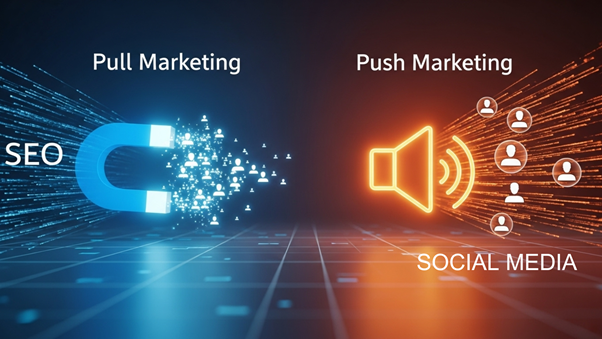
SEO focuses on improving the ranking of content on search engines like Google, where users actively seek information, products, or services. This is a “pull marketing” method, aimed at attracting customers with specific needs. Google maintains market dominance, holding approximately $79.9\%$ of the search market share according to StatCounter. This underscores the importance of optimizing content according to Google’s algorithm to reach the right audience.
Conversely, Social Media is a content “push marketing” channel, distributing information to users via newsfeeds or personal connection networks. It helps build brand awareness, community engagement, and fosters virality. A notable trend is the intersection of traditional search and social media. Platforms like YouTube, TikTok, and Pinterest are increasingly becoming powerful search engines where users look for diverse information, from recipes to life hacks. Optimizing content on these platforms for their internal search capabilities (dubbed Social SEO) is a critical factor for expanding reach.
2. Social Signals and Their Impact on SEO Rankings
The question of whether “social signals” (likes, shares, comments) directly affect SEO rankings has been widely debated for years. Although search engines do not directly use these signals as ranking factors, many experts agree that they play an indirect role as a powerful “SEO catalyst,” significantly contributing to increased traffic and improved rankings.
- Social Media Profiles Rank Prominently in Search Results: Especially for brand-related keywords, social media profiles often appear immediately after the main website results on Google’s Search Engine Results Page (SERP). They may even be displayed in Google’s Knowledge Panel, providing additional touchpoints for customers to discover the brand.
- Social Media is a Critical Traffic Source: Social media is a significant traffic source for many organizations. Google Analytics treats it as a separate entity, providing in-depth analytics on user behavior originating from this channel. Data from Google Analytics can help you better understand the performance of social media traffic versus other channels and determine which social networks drive the most traffic.
- Social Links Act as Traffic Drivers: Using social media accounts to promote new content can be a major catalyst for attracting high visitor volume. Brands active on social media have the potential to naturally build more backlinks, thanks to enhanced visibility and encouraging brand advocates to share content.

II. Building Quality Multimedia Content: Optimizing Algorithms and User Experience
For your multimedia content to achieve high effectiveness, a comprehensive optimization strategy is needed, focusing on both technical elements and user experience.
1. Embracing New Trends: Keywords Shift to Topics and User Search Intent
Artificial Intelligence (AI) is changing how search engines analyze and recommend content. With the advancement of machine learning and natural language processing, search engines can now deeply understand contextual meaning, making optimization solely based on exact keywords less effective.
Merely scattering keywords in content is no longer enough. Instead, you need to truly understand the topic that a keyword or phrase represents, and delve into exploring that topic from every angle to provide the most comprehensive and valuable information. This is known as Topical Authority. You should cover the topic in the format and language your target audience prefers, while anticipating what they might want to search for next.

2. E-E-A-T: Guiding Credible and Quality Content
To solidify your credibility in Google’s eyes and achieve high rankings, adherence to the E-E-A-T principles (Experience, Expertise, Authority, Trustworthiness) is crucial:
- Experience: Demonstrate the content creator’s real-world experience on the subject.
- Expertise: Ensure the content is written by or supervised by someone with deep knowledge in the field.
- Authority: Build reputation through backlinks from reputable websites and be recognized as a leading information source.
- Trustworthiness: Provide accurate, transparent information, clearly cited evidence, and frequent updates.
3. Optimizing for Prominent Appearance: Featured Snippet, AI Overview, and Rich Results
In an effort to provide targeted information as quickly and easily as possible, Google has introduced new features on the SERP such as Featured Snippets, AI Overview (AIOs), and People Also Ask (PAA). These display prominently, attracting user attention and even providing direct answers right on the search results page, reducing the number of actions users need to take.
To optimize your multimedia content for appearance in these prominent positions:
- Use Questions in Headings (H2, H3): A question-format heading signals to the search engine that you are answering a specific query.
- Answer Questions Directly: If you are targeting a related question or keyword phrase, provide a concise, brief answer right at the beginning, and then delve into more detail.
- Format Content as Lists or Tables: Structuring content into bullet points, numbered lists, or tables makes it easier for Google to extract and display it as a Featured Snippet or AIO.
III. Advanced On-Page SEO Strategy for Multimedia Content
On-page SEO optimization involves actions you perform directly on your website to help search engines understand and index the content effectively.
1. SEO-Friendly URL Structure and Engaging H1 Title Tag
- URL and Slug: Create descriptive, understandable URLs that reflect the website structure and page content. Search engines analyze URLs to identify keywords and understand the hierarchy. Use hyphens (-) to separate words for clarity.Example:
www.reputyze.asia/blog/optimize-digital-media-content-seo - Page Title (H1 Heading): This is one of the first pieces of content that search engines crawl. The H1 should clearly reflect the main topic of the page and compel the reader to continue. Each page should only have one H1 tag, containing the main keyword and succinctly summarizing the content.
2. Compelling Meta Description and Clear CTA
- Meta Description: Summarizes the page content, helping search engines connect the content with relevant queries. The Meta Description also often displays in the SERP, directly influencing the user’s click decision. Write an accurate, engaging Meta Description, naturally including the target keyword and using strong verbs to encourage action (e.g., “Discover,” “Learn,” “Elevate”). Limit the length to under 170 characters to ensure full display.
- Alt-text (Alternative Text): Provide detailed, informative descriptions for images. This not only helps search engines understand the content but also ensures accessibility for users when the image fails to load or for visually impaired users using screen readers.
- Captions: Use captions to describe charts, graphs, or other important visual elements.
- Size Optimization: Compress images and videos to reduce page load time. Ensure they are automatically adjustable (responsive) for optimal display on all devices.
3. Schema Markup and Internal Linking: Enhancing User Guidance
- Schema Markup: Helps search engines understand the specific meaning of content elements. This increases the likelihood of your snippet appearing as a Rich Result. In addition to general types, pay attention to
VideoObjectschema andImageObjectschema for multimedia content. - Internal Linking: Helps search engines and users navigate and discover content on your page.
- Show Relevance: Link to truly useful pages, demonstrating how pages relate to each other and proving your topical authority.
- Guide Users: Direct users to additional resources they may be interested in.
- Use Descriptive Anchor Text: Use clear and descriptive anchor text to let users know where the link leads (e.g., “content marketing optimization strategy” instead of “see more here”).
IV. Elevating Presence on Social Platforms with Social SEO
Your multimedia content needs to be optimized not only for Google but also for social platforms, where billions of users spend time daily.
1. Optimizing Social Media Profiles: The Foundation for Discovery
Fill in as much detail as possible on all your social media profiles. Whether it’s the comprehensive “About” section of Facebook or the brief Bio of Instagram, don’t waste this space. Ensure you integrate industry and brand keywords, contact information, and relevant links to your website. This helps your profiles be more easily found when users search directly on the social platform or via Google.
2. Techniques for Optimizing Posts for Social Search
To maximize the visibility of your multimedia content posts on social media’s internal search engines:
- Relevant Keywords and Hashtags: Use appropriate keywords and hashtags in your titles, descriptions, and captions. However, avoid keyword stuffing.
- Alt-text for Images and Subtitles for Videos: Similar to website SEO, Alt-text for images and subtitles for videos (especially on YouTube, Instagram, TikTok) not only improves accessibility but also provides context for the algorithm, helping your content be found more easily through visual or voice search.
- Location Tags: If your content has a local element, using location tags will help it appear in area-specific search results on social media.
- Optimize File Names: Use keywords and key phrases in the video and image file names before uploading.
- Image and Video Quality: Social platforms prioritize high-quality content. Sharp, engaging images and videos not only attract users but are also favored by algorithms, which is beneficial for visual search.
3. Leveraging Social Data for Effective Content Production
When seeking new content ideas, refer to your own social media feed. Social media is a goldmine of data on trends, questions, and the language your target audience is using.
- Social Listening: Use Social Listening tools to quickly grasp trending topics, problems the audience is facing, and the keywords and hashtags they use. For example, monitoring conversations about “digital transformation difficulties” or “effective advertising strategies” can provide ideas for in-depth articles.
- Converting Insight into Content: Turn deep insights from Social Listening into valuable multimedia content products. If you notice many questions about “how to measure social media campaign ROI,” you can create a detailed guide article or an easy-to-understand explainer video.
4. Encouraging Sharing and Building Backlinks from Social Media
- Make Website Content Easily Shareable: Ensure your website has visible, easy-to-use social media sharing buttons on your blog posts and product pages. A simple click to share is a factor that encourages users.
- Encourage Virality: Call on employees, partners, or influencers (KOLs) to share your content. This is an effective way to expand reach beyond your immediate network.
- Publish “Linkable Assets”: Create unique, high-value resources such as infographics, original research reports, or e-books. These types of content are likely to be referenced and linked back (backlink) naturally by other websites, helping build your domain authority.
- Ensure Consistent Publishing Frequency: Build a regular editorial calendar and stick to it. Maintaining a steady posting frequency not only retains the audience but is also a positive signal to algorithms.
Conclusion: Building a Comprehensive Multimedia Content Strategy for the Future
In the digital age, where every business strives to assert its position, creating quality multimedia content is not enough. Only when that content is strategically optimized for both SEO and social media can we transform creative products into powerful tools that attract traffic, build brands, and generate real conversions. By focusing on user intent, building topical authority, leveraging advanced AI search features, and maintaining a perfect user experience, your business will not only remain stable but also thrive in the potentially rich digital market.
Related Journals