
12 Core Elements and Top Tools for Building a Professional E-commerce Website in 2025
Date: 2025-03-05

Build an ecommerce website the right way is no longer just about being online—it’s about creating a conversion-driven platform in a market with over 2 billion regular online shoppers. While the global e-commerce boom offers massive growth potential, millions of e-commerce websites compete daily, making it harder for brands to stand out and operate effectively. To succeed in 2025, you need a systematic strategy and a strong focus on the core essentials that power performance, trust, and scalability.
I. Foundations of a Credible and Effective E-commerce Website
An E-commerce website is an online sales channel established by a business itself, intended to facilitate buying, selling, and providing services to customers. A professional website helps users easily search for products, receive support, and complete transactions quickly. To achieve this, an E-commerce website must ensure the following basic elements:
- Clear Product and Pricing Display: Customers need to easily find and research the products or services offered.
- Optimized Shopping Cart System: The cart must be scientifically designed and organized, allowing customers to quickly add, view, and modify products.
- Diverse Customer Support Channels: Options like live chat, FAQ pages, community forums, or support via email and phone must be available to resolve inquiries promptly.
- Security and Safety for Payment Transactions: All information related to customer payment cards must be strictly protected. Using the SSL security model and the HTTPS protocol is crucial to ensure payment safety.
Secure payments and HTTPS are non-negotiable when you build an ecommerce website customers can trust.

II. 12 Core Elements for Building a Professional E-commerce Website and Optimizing Customer Experience
For a new business’s E-commerce website to truly stand out in a competitive market, it must focus on these essential factors:
1. Website Design Aligned with the Product Niche
The website design, including the interface, colors, layout, and logo, must complement and accurately reflect the nature of the products you sell. For example, a website specializing in food will have a significantly different style than one selling technological gadgets, creating consistency and professionalism in the eyes of the customer.
2. Interface Optimization for All Devices (Responsive Design)
An E-commerce website must be optimized to display perfectly across all screen sizes, from desktops and laptops to smartphones and tablets. According to statistics from Mobiloud, over 64% of global web traffic came from mobile phones in June 2025. By concentrating only on optimizing your website for a single device interface, such as the traditional desktop, you risk missing out on a large volume of potential customers accessing from diverse devices today. Choosing a theme with built-in responsive features is the simplest solution to ensure this compatibility. Mobile-first design is essential if you build an ecommerce website for modern shoppers.
3. Creating a User-Friendly Interface (UI)
A friendly user interface is a key factor that helps customers easily find, view, and navigate the website, thereby increasing the likelihood of completing transactions. Characteristics of a friendly interface include: clean design, intuitive navigation, clear Call-to-Action (CTA) buttons and links, legible fonts, flexible information structure, pleasant contrasting colors, and especially fast page loading speed.
4. Integrating Powerful Search and Product Filtering Functions
Customers today are familiar with product filtering options on major e-commerce platforms like Amazon or Alibaba, or typical Vietnamese platforms like Shopee and Lazada. Integrating multiple filters (by price, rating, brand, location, warranty type) along with an automatic search suggestion feature saves customers time and quickly helps them find the desired product.
5. Ensuring Essential, Mandatory Pages
To provide a seamless shopping experience, an E-commerce website must have the following basic pages:
- Homepage: The “front door” of the website, displaying featured products, promotional messages, and bestsellers.
- Category Page: Shows related product groups, bridging the gap between the homepage and individual product pages.
- Product Page: Details individual products, including price, variations, shipping options, features, color, size, and reviews. This is where the customer makes the purchase decision.
- Shopping Cart: Allows customers to add desired products to a single location and purchase them simultaneously.
- Payment Page: Contains fields for customers to enter payment information, and can integrate appealing options like gift cards, promo codes, and reward points.
- Return & Refund Policy: Extremely important for building trust. About 30% of products ordered online are returned, and over 80% of users avoid purchasing from websites without this policy. Therefore, your website must clearly inform customers of this policy beforehand.
- Terms & Conditions: Defines proprietary rules and guidelines not covered elsewhere, protecting the rights of both consumers and the business.
A frictionless checkout is critical when you build an ecommerce website to maximize conversions.
6. Developing Engaging Website Content with Quality Images/Videos
Since customers cannot physically inspect the product before shopping online, they rely entirely on the information you provide. Therefore, product descriptions must be compelling, provide full details on weight, size, color, and, most importantly, be truthful to maintain credibility. Additionally, high-quality images and videos create exceptional appeal in the customer’s mind.
7. Integrating Diverse Payment Options
Providing multiple payment solutions is essential to serve a broader customer base. Besides common methods like Visa or Mastercard, integration with popular payment gateways in the target market, such as PayPal, Stripe, American Express (in the US) or Razorpay, Instamojo (in India), is necessary.
8. Offering Diverse Shipping Choices
According to Forbes, over 84% of customers prefer purchasing from brands that offer free shipping services. However, fast shipping costs can increase significantly for sellers. To address this, many E-commerce websites now offer multiple shipping options, from free delivery to rapid services (like fast delivery, economy delivery, Viettel Post in Vietnam) with corresponding costs. This allows customers to choose the solution that best fits their time, value, and affordability.
9. Prioritizing Security and Data Protection
When placing an order online, customers must provide sensitive information such as phone numbers, credit card numbers, email addresses, and bank accounts. Therefore, website security is paramount to prevent hackers from stealing this valuable information. Google also does not prioritize websites lacking SSL Certificates and the HTTPS protocol. Businesses must proactively adopt security software and solutions to strengthen defenses against cyberattacks.
10. Enabling Quick Guest Checkout
The Guest Checkout feature allows users to place orders without creating an account. Having this option can increase the customer purchase conversion rate on the website. This is because customers no longer have to re-enter all their personal information during each purchase, making the checkout process faster and more convenient.
11. Encouraging Product Reviews and Ratings
Product reviews and ratings are invaluable feedback from customers after using a product. Positive reviews are as good as “gold” for any online business, as 87% of customers now conduct online research before making a purchase. They tend to choose products with good reviews and high ratings. Therefore, the website must allow customers to leave reviews (text, short video, image format) under each product page.
12. Choosing the Right Content Management System (CMS)
Operating a website involves many complex tasks such as adding products, publishing articles, managing orders, verifying payments, processing refund requests, and updating the interface. For non-technical users, managing the website becomes much easier with the support of a Content Management System (CMS).
A CMS is a simplified “toolkit” that provides all the necessary options to create, edit, format, and publish web content on a centralized platform. Popular CMS platforms today include WordPress, Wix, OpenCart, and Magento.
III. Top Tools for Building an Effective E-commerce Website
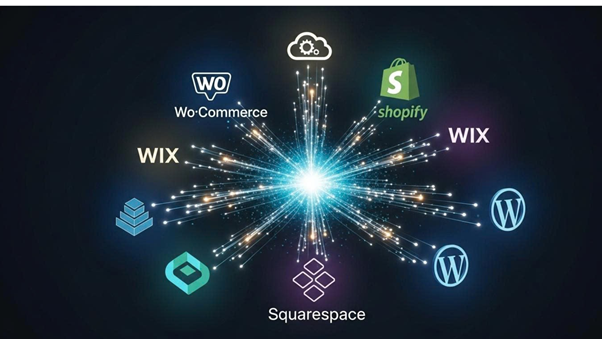
After understanding the structural elements and design tips, choosing the right tools is the next step to start building your business’s website. Here are 5 popular E-commerce website building platforms:
- WooCommerce: A free, open-source plugin for WordPress, providing all necessary functions for an E-commerce website, such as shopping cart, product management, payment processing, and promotions.
- Shopify: A cloud-based SaaS platform that allows users to easily create online stores with features for product management, shopping carts, and payments. It offers various pricing plans ranging from $29 USD to $299 USD per month.
- Wix: An online website design platform that allows for easy creation via drag-and-drop actions, requiring no coding knowledge. It has a free version and paid plans starting at $14 USD per month for advanced features.
- Squarespace: Provides professional website templates, simplifying the E-commerce website design process. Costs range from $14 USD to $49 USD per month, depending on the service package.
- WordPress: A popular open-source platform, originally used for blogging but has evolved into a versatile tool for all types of websites. It supports numerous free plugins and themes, making it a preferred choice for small and medium-sized businesses looking to build their brand identity. Both free and paid plans are available for premium utilities.
IV. Conclusion
The E-commerce market is a dynamic platform that requires meticulous preparation and solid knowledge to succeed. With increasing competition, building a quality E-commerce website, optimizing user experience, and implementing core factors is the key to differentiation and breakthroughs.
Are you struggling in the fiercely competitive E-commerce market, finding that your current website isn’t retaining customers or generating orders as expected?
Don’t let your business fall behind as users become more demanding and shopping behaviors constantly change.
Contact Reputyze Asia today for comprehensive strategic consultation – from building an effective interface and optimizing user experience to implementing core growth factors to help you accelerate revenue and dominate the market!
Ultimately, to build an ecommerce website that scales in 2025, you need the right features, tools, and continuous optimization.
Related Journals